Pooja room: North-East or centre
Should the pooja room go in the North-East or the centre?
The pooja room belongs in the North-East, the zone of clarity and the divine. The Brahmasthan at the centre should stay open, never closed in by a small room.
Answered by Gurmeet Singh, Vastu practitioner since 2020 · updated
What do these zones govern?
Northeast (NE)
When balanced, NE delivers clarity of mind, new ideas, and direct vision of truth — solutions to life's problems begin arriving on their own.
A toilet or heavy fixture in the NE is one of the worst Vastu defects: tied directly to a lethargic mind, inability to generate new ideas, and chronic creative blocks.
Remedy: If the toilet cannot be moved, a continuously-lit spotlight minimises the damage. Otherwise clear the area completely.
The Northeast zone in the Vastu guide →What does the Vastu library say?
The Vastu Purush Mandala — the living soul of a building
Every enclosed space grows its own living energy map. Specific points carry specific qualities, and that map stays consistent across buildings.
The ancient texts describe a Vastu Purush — a living presence that takes up residence inside any built space the moment the space comes into being. The myth behind him is symbolic, but the observation is precise: specific points in a building consistently carry specific qualities of energy, regardless of the building's size, style, or location. The 16-zone grid we use today is a practical map of those points. Clairvoyants through the ages have described the same fields in the same places; modern sensitives using dowsing still report the same map. The point is not to worship the Purush but to work with him: honour the zones, let each hold what it is best at holding, and the building quietly supports you. Ignore the zones and the building starts to push back.
Read it in the Vastu library →Why sixteen zones — not four or eight or thirty-two
Four cardinals split into four sub-zones each gives sixteen. Each is small enough to govern one life-activity cleanly.
The four cardinals — north, east, south, west — are only the start. Between each pair sits a corner; between each corner and its adjacent cardinal sits a finer transition. Divide each 90° quadrant into four equal 22.5° slices and you arrive at sixteen zones, each governing one distinct life-activity: money, social connection, cash flow, fame, relationships, education, gains, support, attraction. Sixteen is fine enough to attach one life-activity cleanly to each zone, and coarse enough for an owner to actually read the compass and act on it. Finer divisions — 32 entrances, 45 devtas, 81 *pada* — exist for specialist purposes. For everyday Vastu, the 16-zone model is the practical lingua franca.
Read it in the Vastu library →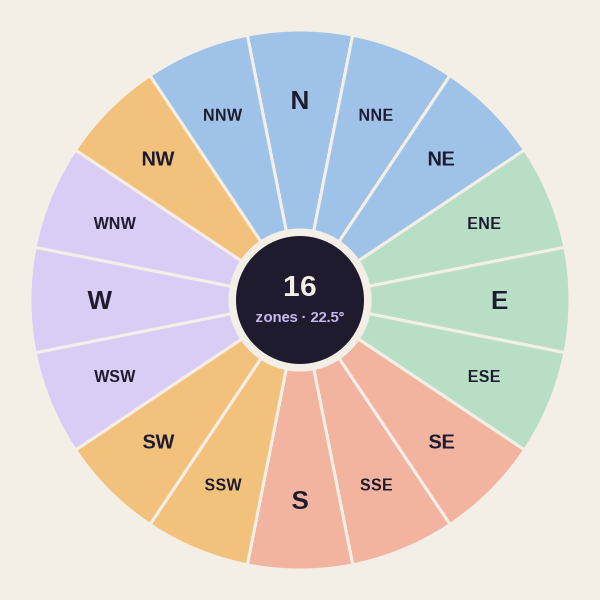
Sources
Classical texts: Mayamata of Mayamuni and Manasara on Architecture and Sculpture. True north for your plan: NOAA magnetic declination calculator.
Replies (6)
If you'd like me to read the whole plan, submit it at spaceflowmapai.com/consult or message the desk on WhatsApp: India & Asia +91 98781 37212, Americas +1 703 507 5668. I read every case personally.