Entrance 60° from true North
What does an entrance 60° from North mean?
An entrance about 60° from true North falls in the East-North-East to East band, a favourable side of the wheel. Which of the eight East padas the door sits in decides the reading.
Answered by Gurmeet Singh, Vastu practitioner since 2020 · updated

Plan Nov 2, 2025 9:43 am
What do these zones govern?
East-Northeast (ENE)
When balanced, ENE keeps life full of happiness; inhabitants find moments of fun and rejuvenation easily, even during hard times.
A toilet or unkempt clutter in ENE is named in the book as a direct cause of dissatisfaction with family and life — a slow erosion of joy.
Remedy: Open this zone for rejuvenation activities (yoga, prayer, meditation, music) and keep it light and uncluttered.
The East-Northeast zone in the Vastu guide →East (E)
When balanced, East accelerates social connections, attracts influential people, and opens opportunities through networking and visibility.
A toilet in the East is named in the book as the reason politicians and gurus lose their following — it stops social engagement and damages careers built on connection.
Remedy: Re-energise with light, sun symbols and openness. Displayed achievements and certificates amplify recognition.
The East zone in the Vastu guide →What does the Vastu library say?
The 32 entrance positions in brief
360° divided by 32 gives 11.25° per position. Each is ruled by a devta, and the effect of a door there is the devta's signature.
The full compass of 360° is divided into 32 segments of 11.25° each. Each segment is the seat of a specific energy field named, in the old texts, after its ruling devta. A door placed there receives that signature — for better or worse. E3, ruled by Jayant, is a classical auspicious entrance: money, profits, and success. E1, ruled by Shikhi in the zone of water, gets disturbed when a door (which disposes rather than holds) is placed there; fire accidents and short temper follow. The full 32-entrance table is one of the oldest Vastu diagnostics: identify the segment the front door sits in, match the symptoms in the house to the effect described, and you have the root cause — often in minutes.
Read it in the Vastu library →Why the entrance decides more than you think
The entrance is the point where outer space meets inner space. It sets the tone of everything inside.
The entrance is the only point at which the space inside a building actually communicates with the space outside. Cross it and you move from the conscious world into the subconscious world of the home. Because of this role, the location of the door — exact location, not just general direction — governs the whole effect of the building. Elders and experienced businessmen, in the old days, would read a building's fortunes just by looking at where its main door sat. The underlying truth is simpler than magic: the entrance decides which of the 32 energy fields is the first to touch everyone who enters, and that first touch colours every other interaction they will have inside.
Read it in the Vastu library →Marking direction is the first step
Before any advice can help, true magnetic north has to be marked on the plan. Everything Vastu does is anchored to that line.
Vastu begins with a compass reading. Not a rough 'the house faces east' from memory, but a measured magnetic-north line drawn onto the floor plan. Every zone, every placement, every remedy is located relative to that line. Phone compasses, standalone magnetic compasses, and Vastu compasses all work, though each needs to be held level and kept away from metal and electronics. Once north is marked, the plan can be divided into the 16 zones of 22.5° each, and every room in the house can be assigned to one — typically by the position of its centre point relative to the building's centre. Get this step wrong and every subsequent recommendation is aimed at the wrong zone.
Read it in the Vastu library →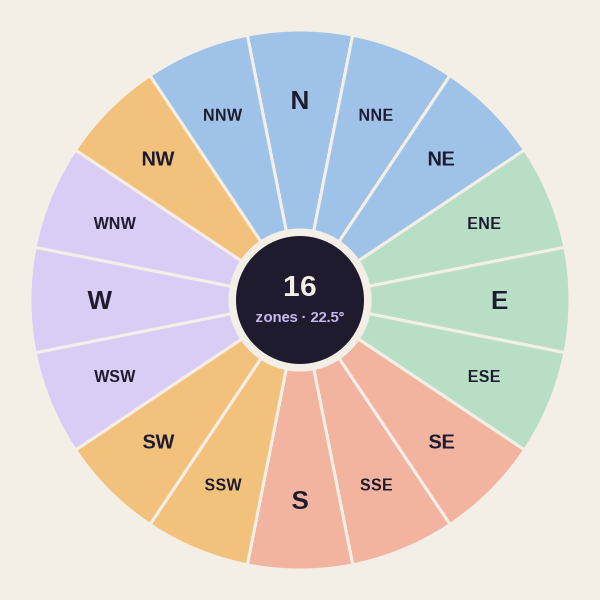
Sources
Classical texts: Mayamata of Mayamuni and Manasara on Architecture and Sculpture. True north for your plan: NOAA magnetic declination calculator.
Replies (2)
The primary areas of concern are as follows:
• Toilet in SSE: This placement can disrupt the energy of power, confidence, and leadership, potentially affecting one’s personal drive, motivation, and growth.
• Kitchen stove in ENE: This zone governs clarity, focus, and vision. A stove here can create mental confusion, misunderstandings, or emotional distance in relationships.
• Dining room in ESE: This area relates to social harmony and nourishment. When imbalanced, it can lead to strained communication or irregular eating patterns.
The main entry in the NW/WWN zones is generally neutral, but depending on the symptoms or challenges you’re noticing — such as instability, stress, or health fluctuations — certain Vastu remedies may help harmonize the space and restore balance.