New office, business dropped
Why does business drop after an office move?
A drop in business after an office move nearly always comes down to three things the floor plan shows. The first is the entrance pada the office door sits in.
Answered by Gurmeet Singh, Vastu practitioner since 2020 · updated
What does the Vastu library say?
Why the entrance decides more than you think
The entrance is the point where outer space meets inner space. It sets the tone of everything inside.
The entrance is the only point at which the space inside a building actually communicates with the space outside. Cross it and you move from the conscious world into the subconscious world of the home. Because of this role, the location of the door — exact location, not just general direction — governs the whole effect of the building. Elders and experienced businessmen, in the old days, would read a building's fortunes just by looking at where its main door sat. The underlying truth is simpler than magic: the entrance decides which of the 32 energy fields is the first to touch everyone who enters, and that first touch colours every other interaction they will have inside.
Read it in the Vastu library →The 32 entrance positions in brief
360° divided by 32 gives 11.25° per position. Each is ruled by a devta, and the effect of a door there is the devta's signature.
The full compass of 360° is divided into 32 segments of 11.25° each. Each segment is the seat of a specific energy field named, in the old texts, after its ruling devta. A door placed there receives that signature — for better or worse. E3, ruled by Jayant, is a classical auspicious entrance: money, profits, and success. E1, ruled by Shikhi in the zone of water, gets disturbed when a door (which disposes rather than holds) is placed there; fire accidents and short temper follow. The full 32-entrance table is one of the oldest Vastu diagnostics: identify the segment the front door sits in, match the symptoms in the house to the effect described, and you have the root cause — often in minutes.
Read it in the Vastu library →Activity relocation — the ideal remedy
When possible, the cleanest fix is to move the activity to a zone that actually supports it.
Every Vastu problem has the same cleanest fix: move the activity to the zone that supports it. A kitchen in the NE, where fire disturbs water, is remedied by moving the kitchen to the SE where fire belongs. A toilet in the SW is remedied by moving it to the SSW or WNW, where disposal belongs. Activity relocation is the gold standard because it attacks the root cause instead of masking symptoms. The realistic limitation is that, in perhaps 80% of flats and apartments, load-bearing walls and plumbing make relocation impossible. That is why the other 15 techniques exist — but when relocation *is* possible, it is always preferable to an overlay remedy.
Read it in the Vastu library →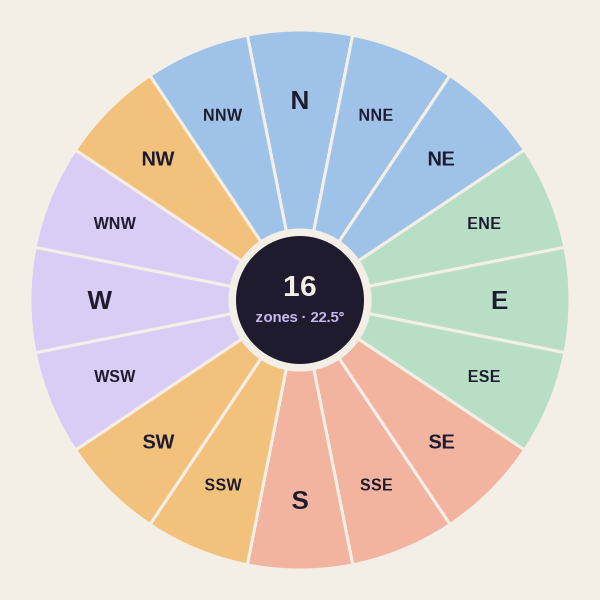
Sources
Classical texts: Mayamata of Mayamuni and Manasara on Architecture and Sculpture. True north for your plan: NOAA magnetic declination calculator.
Replies (2)